The State of Always Asking: A Conversation with Eula Biss
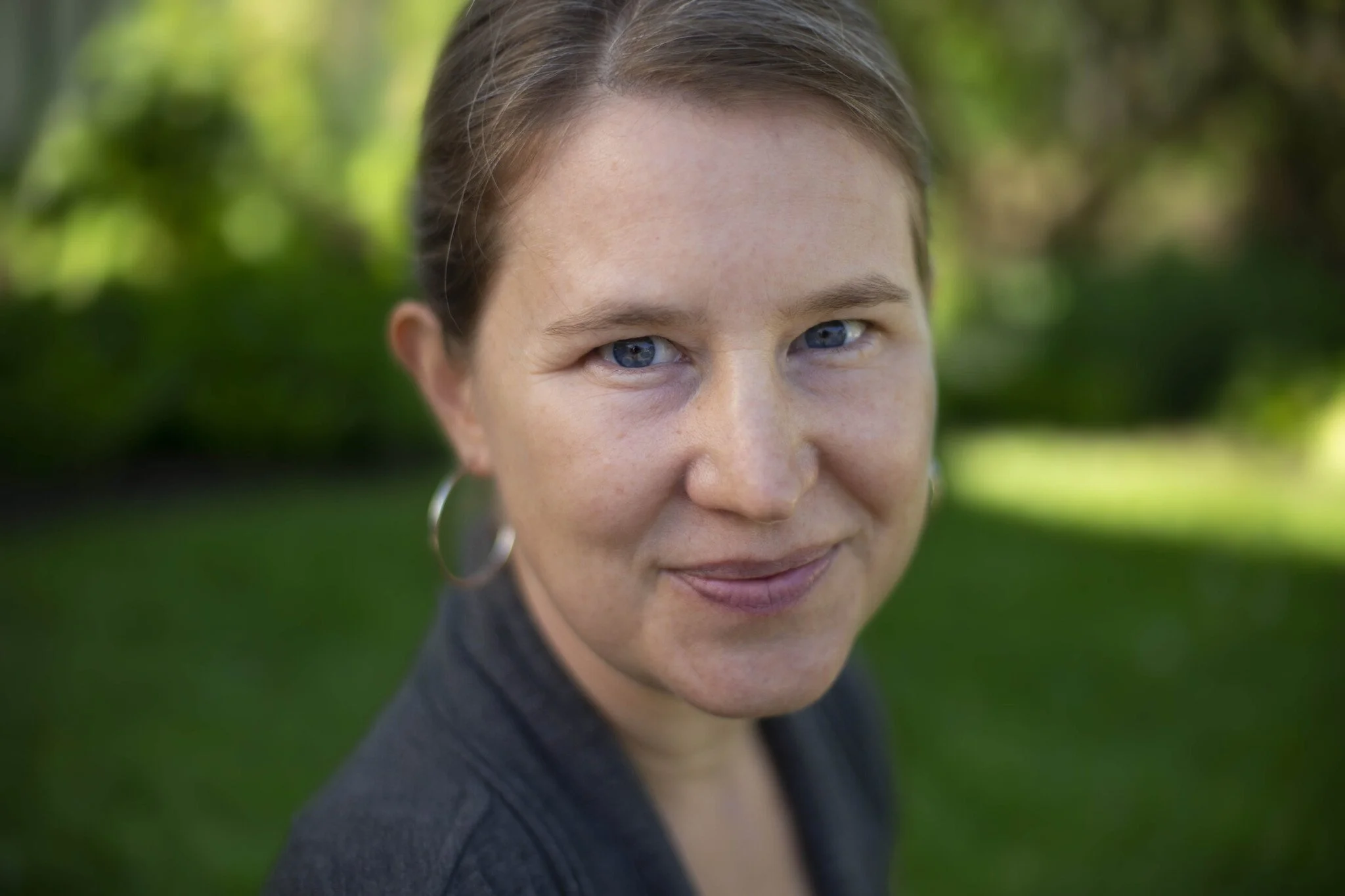
Eula Biss is the author of four books: Having and Being Had (2020), On Immunity (2014), Notes from No Man’s Land (2009), and The Balloonists (2002). Her work has been translated into a dozen languages and has been recognized by a National Book Critics Circle Award, a Guggenheim Fellowship, a New America Fellowship, and a 21st Century Award from the Chicago Public Library. She is currently at work on a collection of essays about how private property has shaped our world.
For the past twenty years, Biss has taught writing in large lecture halls and small community bookstores, at public elementary schools and private universities. She developed a commitment to progressive education at Hampshire College before earning an MFA in nonfiction writing from the University of Iowa. She lives a mile from Lake Michigan, where she swims in sun and shadow.
On January 21st, 2026, The Interlochen Review editors Cam Joyce, Jade Rothbaum, Alisha McMillan, and Alex Stillwell, sat down with Eula to discuss her books, including Having and Being Had, On Immunity, and Notes from No Man’s Land, as well as her relationship with political subject matter, thoughts on craft, and research process.
Cam Joyce: In Having and Being Had, you wrote very short flash essays to convey your points. How did you navigate keeping essays, like micro-essays, to that length and still manage to get your themes across?
Eula Biss: There's a lot of ways to think about that book formally. I didn't actually think of those as micro-essays or flash nonfiction or anything like that. Originally, when I started writing, I was thinking of writing a series of prose poems. But as the project evolved, I started to feel like the works, even though they were titled individually, were not singular works: that the meaning was made by them in conversation with each other. I actually think of that book as an essay in parts, rather than a collection of essays.
Most people who I've talked to about it call it a collection of essays or micro-essays, so it's not at all an unusual way of seeing it; it just isn't the way that I conceived of it from the inside. I didn't know what 'the point' was when I was starting to write, and I was working towards it. Partway through, it occurred to me that what I was saying or exploring was only going to be fully expressed through the accumulation of these parts.
It took getting most of the way through the book before I could look back and say, “Okay, this is what the book is actually doing and saying.” Then, I could take out the pieces that were irrelevant and move them around so that what the book was saying could be more available to readers. It took doing most of the writing before it was clear to me where the emphasis should be and what it was that the book was exploring.
CJ: Further, on the revision process: was that a lot of cutting down words or was it more about adding new essays?
EB: For that book, it was a several stage revision process. Each titled piece went through its own process. Usually it was expansion first. Those pieces started out very compressed, just a moment in time. In those pieces, the initial phase was getting the most out of those moments and making them say the most possible. Then, I'd expand out: sometimes through research, through reading books, sometimes just through further meditation on the moment. That was a good year or so spent expanding those pieces out.
Then, when I had a lot of them and I'd refined them, there was the second phase of revision that was about revising the whole book with the pieces together. That was a lot of cutting out the ones that weren't relevant. I cut out the same word count as the finished book, so I cut a book out of the book. I always thought, “I'll publish those separately.” It makes me feel better about cutting that much if I think I'm going to do something with it, but I never did do anything with it.
There was a lot of cutting and then a lot of rearranging. It probably took six months of arranging and rearranging. I would print out the whole book and go to my attic, where I laid out all the pages of the whole book, so I could see the arrangement. Then, I would walk around from one section to another. Multiple times I thought, “Okay, I've got it. This is the arrangement for the book. Phew, finished.” Then a week later, I'd read it through and say, “No, there's a problem.” And I'd do the whole thing all over again. Sometimes, I'd hit an arrangement that felt right to me and then realized there were gaps and that I had to write more into those gaps. I’m not sure how many times I did that.
Jade Rothbaum: You have a really unique way of circling questions, juxtaposing ideas and letting the white space form connective tissue between them. Can you speak on how you move from many thoughts over many things to something more condensed?
EB: I work with my natural thought process; I'm naturally an associative thinker. So, what can look to readers like thoughts about lots of different things feels to me like thoughts about the same thing, because I think associatively through one thing, which leads me to another thing, which leads me to another thing. Part of my process as a writer is to make that associative movement feel organic and necessary to the reader. It makes sense to me, but those leaps sometimes are too big to make sense to a reader. I have to ask myself, why am I moving from this to this to this? What is the associative connector?
When I was a newer writer, I was encouraged by one of my mentors to write into the white space to make a note about what it is you believe this white space is saying. That was a very useful exercise. I don't do that anymore because now it's folded into my process, but I still ask myself: what do I think is happening in this white space?
Sometimes, it's too much to ask of a reader. There needs to be a little more language on the page. And sometimes the leap is a little wide, but I think that at its laziest, this kind of writing can just use white space as an excuse to not finish a thought, or lack follow through. I try very hard to not have the white space performing that function.
Alisha McMillan: You write a lot about bigger political issues and a lot about current events. How do you keep your readers from getting overwhelmed by all of this?
EB: I almost never think of it that way. I don't think, “Oh, a reader's going to get overwhelmed.”
With that book [Notes from No Man's Land], by the time the book was almost done, I was like, “oof, this is a lot, actually.” I did plan for the first essay in that book to be a lighter essay. Which, as you know from reading it, it's not a light essay at all. It begins with a litany of lynchings. So, that didn't pan out the way I thought it was going to. I think about that the way I think about any piece of writing: that there has to be surprises. There's a lot of ways of writing about racism that wouldn't be surprising to anyone. There's a lot that we are all aware of, that is dismal and depressing. I see a lot of that writing around that's repeating what we all already know.
In that book, particularly, one of the things I was writing against, especially when it comes to racialized oppression, is the information, history, and knowledge that is intentionally obscured or suppressed for the purposes of racist oppression. This is damage that is done to both the oppressors and the oppressed. I was thinking a lot about whiteness in that book and about how racism damages white people. One of the ways is on the level of knowledge. There's a lot of things we don't know because we've constructed education systems that don't look at certain histories and don't teach us a false history of this country, a false history of what it means to be white.
For a lot of people of color, there's a lot of education that happens in the home around filling in histories that aren't provided in school. In some white families, some of that happens, and in some white families, none of that happens. My project in that book was self-education, but also bringing up some of this buried information onto the page and calling forth things that surprised me and that I thought might surprise other people.
For instance, there's an essay about this town, Buxton, Iowa, this fully racially integrated town. It was majority black in Iowa around the turn of the 20th century, so early 1900s, which surprised me because I wouldn't have thought that there was a town that was majority black anywhere in Iowa during that time period. I conceive of it [Iowa], and many people do, as a very white state, though that's still untrue. That's a myth from the beginning. Iowa was never white and is not white now. I was interested in recovering this history of what was going on there and examining what life looked like in this integrated town as a way of thinking about what's possible now in Iowa. If this happened over 100 years ago, could it happen again, and what would the conditions need to be? That’s how I try to keep the work from feeling depressing and redundant: by finding surprises and bringing in information that feels lost, buried, and suppressed.
The book opens with something that I knew about and that most people who have even the barest education in American history know about, which is that there were a lot of lynchings in this country. But, until I wrote that essay, I had not read detailed accounts of lynchings, and so that became the research for that essay. Even though I thought I knew about that history, once I did the research, I realized that I didn't know what this really looked like. I didn't know that a lot of those lynchings involved sexualized violence, mutilation of the body, and people's genitals being cut off. It's more horrific than I would have ever imagined. And that's part of why I wanted to bring that history to the page, too: to refresh our awareness that, however bad we thought it was, it was worse.
Alex Stillwell: In Having and Being Had, your writing is thoughtful and meditative, but you remain clear and concise. What writers have inspired your style and what do you take from them?
EB: Concision is something that I really value in my reading and my writing. Some of the people who I had in mind were actually poets. I have a lot of interaction with poetry and poets, both in my lived life, like in my community, but also in the influences on my writing. The book opens with a quote from Emily Dickinson. She was on my mind, and she’s among the most pristinely concise of writers. Concise to a point where part of the mystery comes from the concision. There's real beauty in that.
Anne Carson is another writer who's meant a lot to me, and I don't think you would read Having and Being Had and say, “This person was reading Anne Carson.” The books are so tonally different and stylistically different, but she also has, I think, a very beautiful concision to her work. She has a series of pieces in the book Plainwater that are called “Short Talks” and they have always really spoken to me. I think I first read them when I was in my early twenties. Her “Short Talks” are poems, and so, actually, I think some of the concision was coming from her prose poetry that I've really long admired. I've read prose poetry from writers who are known for other things such as Margaret Atwood. She has some really gorgeous prose poetry that's just her lesser known work; for almost everyone who writes prose poetry, that's their lesser known work.
One of the things I most admire in a writer is concision and the ability to do a lot in a little amount of space. There's books like The Argonauts by Maggie Nelson that are doing a lot, even philosophically, in small amounts of space. That also has a kind of fractured prose style.
AM: It was mentioned earlier how you write a lot about current events and politics, but you also write about the personal and how it relates to you. In your collection Notes from No Man’s Land, there was a lot about the personal and how you used it to build onto the articles, the research, and the news that you were writing about. What was your process in contrasting the two and building on top of each other?
EB: I get some version of this question very often when I talk with writers, and I just don't, in my mind, categorize stuff as personal or political; it's a continuum for me. This is an old-ish idea, depending on what counts as old, but, since the 60s and 70s, the slogan, “the personal is political,” has been important to various movements.
I believe that what happens in the parts of our life that we think of as personal are shaped by the political and expressions of what's going on in politics. A way of exploring your own experience is a way of thinking about how you're impacted by the structures that you live within. In No Man's Land, there was definitely very little separation because I was writing about race and for most of us, racial identity is such a lived experience. It's not even as removed as how your economic system impacts you in Having and Being Had.
For a lot of people, this is a very visceral experience. For me, I think the biggest challenge was bringing unspoken things into the realm of the spoken. Though a lot of people's racialized experience is very felt, very daily, very visceral, especially for white people, there's just a lot that's not talked about.The challenge was talking about the things that weren't talked about. Not so much joining the political or the informational with the personal. I kind of think of everything as information.The knowledge that I get from experience is information and the knowledge that I get from reading is information. And I treat them pretty equally on the page. I think that's why there's a somewhat seamless texture between those kinds of information on the page.
But I know that there's a lot of training for writers against that. I teach college students and a lot of my teaching is about un-teaching things that are not useful, that have been trained into people in high school. I think a lot of people are trained to think of these as very distinct kinds of information that don't belong in the same place and that can't be in the same paragraph or on the same page. Even the undergrads I'm working with now will use an entirely different voice for information that comes from reading a book than they use for information that comes from their own lived experience. So, when they try to bring those things to the same page, there will be a shift in voice, tone, and posture for the narrator from these two kinds of information.
The problems come from the way the information is conceived of in your mind and the way you're trained to write in different voices. I either didn't pay attention during that training or it was something that happened for me that wasn’t as much of a challenge as I see it being for some other writers. That challenge is a tone, texture, and voice challenge: to not handle the stuff you get from reading like you're writing a term paper. You still have to use your essayistic voice. When I work with college students, I'm encouraging them to develop an essayistic voice and then apply it to all the information that they're bringing to the page, no matter what the source of the information is.
AS: In Having and Being Had, you often recall and discuss other pieces of media: music, books, images, poetry. How do you decide what to talk about? What adds or takes away from your writing?
EB: That is a process. The early stages are just total chaos. I let everything in in the early drafts.I'm just drawing from every sphere. There's articles, books, conversations with other people, life experience, artwork. Everything is in there. And then, for me, there's a process of figuring out in each of those individual titled works: what's at the center here? What's the central exploration? What's the central question? What's the central problem or concern?
As I zero in on that, I'm able to clear some clutter out. There's always stuff that made it in because I thought it was interesting or zany or wild or something. Or in some great leap of association, it had some remote connection to what I was talking about. As I refine the work, I clear away the things that don't feel like they're orbiting the center very closely. I don't go into a first draft knowing what the center is going to be. I have to find it, which I think is true for a lot of writers.
I think newer writers can get very frustrated that they don't know what the project is from the get-go. I don't ask that of myself. I don't try to know what's going to happen. I have the slightest inkling that there's something interesting there. Then I draw in materials that will help me hopefully build on whatever that little subconscious inkling is. Then as I draw in more, it becomes both clearer and more obscured. The piece gets messier as I bring in more materials. A really important stage for me is the stage where I refine what it is that I'm encircling and cut a lot away and compress the piece down. Usually after it's been compressed down, I build it out a little bit more, bring in more materials. They're more directly related to what I've identified the center as being in the piece.
JR: When you go from many things to finding your center like you talked about earlier with Having and Being Had, you said you had an entire other book's worth. Does that mean writing everything you can think of, and then cutting it down? How do you find the center as you go? What does that look like on a thought process level? Do you run it through lots of people, or is it more individual?
EB: Yeah, every element that you just mentioned. I'm a very multiple-draft writer, and I number my drafts. When I make significant changes, I number the draft again. I often get up to twenty or so. The early ones would be unreadable to most people, just notes and unfinished sentences, and sometimes I'd just plop down a link to an article or something. It's not an essay at all. The middle drafts are the ones where there's chaos and I've written paragraphs and sentences. They're not necessarily in the right order. But I've drawn in lots of materials and that's where I'm trying to find that center.
I do it in many ways. Every time I sit down to work in those middle stages, I ask myself, what is this really about? What am I asking? What's the central question? Often I'll have a slightly different answer to that every time I sit down to write; it evolves draft by draft. I also very often use the assistance of readers at that point. I'll give it to somebody and ask what they think it’s about, or what it seems to be circling. Sometimes that stage is when feedback is most useful to me. Not the “change this, cut this,” because I know lots of work needs to happen. It's more the, “This is what I see you talking about. This is the idea that seems to be at the center.” Because sometimes it's very obvious to a reader, and it's not obvious to me.
The other thing that helps when the center of a piece seems unreachable to me is when I set it aside and work on other things. Coming back fresh is a really important part of the process. I'll come back in and suddenly realize I see what this is really about. I think your mind keeps working on it when you're not writing and are on other tasks. Some subterranean part of your mind is working. For me, setting aside and letting the piece rest is a very important part of the process if I get stuck. I've learned by now not to just try to push through a piece that isn't moving forward, because I'll write myself to frustration and will usually do a little damage to the piece that way.
AM: You talk about a lot of “heated moments.” And like you said, it's hard to write through frustration. How do you use your emotions as an outlet in all of your writing? Do you use it as more of a vehicle or inspiration? Or do you take a step back when you're feeling strong emotions?
EB: The emotions are definitely the starting point where the writing comes from. The work gets more intellectual later in the process. But almost everything I write comes from a feeling. And it's usually a bad feeling. A lot of the essays and notes from No Man's Land, they originated in an unease or discomfort or sense of something being wrong that I couldn't even put words to.
Even in situations where I could put words to it, I felt that there was more than what I could say. In the piece that's about the neighborhood where I lived in Chicago—Rogers Park—I noticed within weeks of moving there that all these white people were describing themselves as pioneers in this very diverse neighborhood. And it made me deeply uncomfortable.
Part of that was obvious. The history of that word is a distressing history in the Midwest. But there's more there, too. If we imagine ourselves as pioneers, what are we really imagining about this social landscape? I had to then write into that question to really open up the nature of my discomfort and the historical implications of that discomfort and that term itself.
I think feelings of vague, undefined discomfort are almost always the starting point for me that drives me into the writing. It’s where I have to kind of explore and figure out where something is coming from.
Then, there's another emotional sphere that is somewhat separate and that’s the emotional process of going through the writing process itself. This is one thing that has become easier for me as a writer, while I think everything else has become harder. It’s like the more you know, the harder it gets. What's easier, and I tell my students this all the time, is knowing your own process and knowing the emotional trajectory that you go on in your own process will make that emotional trajectory less difficult and scary. So I know by now that I have an initial phase of writing where I start work and I have this sense that I'm on to something and I think, “There's something here.” I'm reading all kinds of stuff. I'm drawing from lots of different sources. I'm feeding the work. Some part of me believes that this is going to be the most brilliant thing I've ever written.
In the process of getting so excited, I bring so much to the page that it creates this chaos. Then, I've got a mess and I feel despair at that point. It's very useful for me now at this stage in my writing career to know I've made it through that part of the process so many times. When I hit that despair, it's less difficult than it used to be because I recognize it as, one, just part of a way station in the process. And two, I know I've gotten through it before. I know the way now. The way is by finding what the central question is, by sorting out what belongs in the essay and what doesn't. It’s also partly through finding a form or a structure for the work and getting the materials in the right order. All of that is hard for my brain to do.
I sometimes don't feel like I'm making progress at all through that part of the process. Sometimes, I've had books that I've written where I've spent a whole year feeling like I'm spinning my wheels and I'm not making progress. Then, at the end of that year, I realize that the book is actually now almost done. I don't know how that happens: that I feel that I'm doing nothing for a year and then suddenly it seems that all the hard work has been done. But I know that now. So, there's this other emotional part that isn't about my emotional reaction to the subject matter. It's about my feelings about the process itself. I think it's very, very useful to chart your own emotional trajectory as a writer and to see how you feel at different points in the process so that, when you hit that feeling again, you'll recognize it.
JR: In On Immunity, you do a great job at capturing what it feels like to live with the limitations of knowledge. As you find more and more information, or other elements are introduced into the narrative, readers get to experience learning with you, questioning with you, wondering and sometimes despairing with you. In the writing process, how do you approach this reconstruction of thought when it often involves pulling on things that are often years old?
EB: Part of how I do that is by writing during the thought process. I don't have a process where I do all my research, learn everything I think I need to know, and then sit down and write from there. I'm researching and writing simultaneously. As I was writing that book, there were things that I, initially, genuinely didn't know. Part of what's on the page is discoveries and a person changing their mind. Part of that is captured through me actually being in that process while I'm writing, and researching while I'm writing. And some of it was casting back into the past.
By the time I started writing that book, I had vaccinated my son and made my decision, but I was still in touch with the part of me that wondered whether vaccination was a good idea. So part of it is just being able to be in conversation with a past self. I had to ask myself what I was feeling or what I was thinking. What were my major concerns? Was I operating from fear or was I operating from knowledge?
I think that this is very important. All autobiographical writing is the ability of the narrator to create a conversation between the self of the writing, the self of now, and a past self. Sometimes it's a far past self and sometimes it's a very recent self. In that book, it was a fairly recent self. And some of my uncertainties remained. Even though I was vaccinating my son on schedule, part of me asked, “Am I putting him at risk? Am I doing damage?” I think that because those uncertainties were still alive, it was very easy for me to access that.
Sometimes, you have to actually go back into your own historical record to access a past self, like reading old journals and diaries or looking at old photos. You actually have to research the person who you used to be. I was recently teaching an essay by Melissa Phibos called “Kettleholes.” In that essay, she goes back and looks at a diary entry from when she was twelve. She tells us as readers that she remembers the day that diary entry was about and she had lied in her diary. She had lied to herself. She had played a game of soccer with a boy who was sexually harassing her, but what she wrote in her diary was “...played soccer with Adam. So fun!” And she was like, “No, it wasn't so fun. But I couldn't admit to myself and I didn't have the language for why it wasn't fun. And I didn't know what was really going on there; that was not fun for me, that was actually humiliating and horrible.” So, there's also that kind of revisitation of a past self. She did it through a diary entry, but I think there are various ways of doing it where, with the knowledge of the moment, you have to cast back to the self of the past and think: what did they not know? What was that person unable to admit to themselves and others? What were their misconceptions about themselves and others.
Part of writing On Immunity was discovering the true nature of vaccination, which I didn't understand when I started writing that book. I didn't understand how unique it is, as a public health measure, in that we're really recruiting the majority of people who will not have a bad reaction to vaccines to protect a minority of people who either can't be vaccinated because they're being treated for cancer or because they're too young or they're too old or they have an immune dysfunction of some sort. So, we've got this minority of people who it's not safe to vaccinate and we're recruiting the majority to create a protective dome around these people, and when we erode the 100% vaccination goal, what we're really doing is creating a situation where a majority is refusing to protect a minority.
AS: In Having and Being Had, you retain piercing honesty and never shy away from personal thoughts. How do you approach the pain that goes between the speaker and the audience and what do you choose to share with the reader or keep to yourself?
EB: In my early drafts for that book especially, I had to fool myself into thinking no one was ever going to see it. In my very early drafts, I said “this is just for you, you never have to publish this.”
I wanted to do my own reckoning around class, money, and economics, for my own personal growth, and I knew that in order to do that, I couldn't lie. I caught myself trying to lie many times. A lot of us lie to ourselves about money and a lot of people believe their class position is very different than it actually is. The way we talk about class in this country totally allows that because everyone falls into this baggy middle class that extends from the upper echelons of society down to what should probably be considered poverty. In some ways, we just don't even have the language for class. We can't talk about class effectively because we don't have terminology for it and it allows us to hide and lie.
I definitely saw those impulses in myself. I was writing and had the impulse to hide, to pretend that my class status was something other than it was to select the details from my life and experience that would suggest a lower class status or more financial struggle. Those details are there and they're there for lots of people. It's a study in how you can create fiction out of nonfiction—those selective details that are very common in conversation when people talk about their financial backgrounds or lives. I think we’re trained to do that. To untrain myself and work through that training, I had to believe I had privacy. I told myself, “you don't have to show any of this to anyone, not an editor, not a friend, not an audience.” Then, as I was revising, I got to ask myself, “Of all this material that you've brought to the page, what's absolutely necessary to make the arguments or points that this book is making?” Some of what was necessary was material that I would have preferred for people not to know. So, there was a feeling of exposure with that work.
That was interesting to me because in previous books I'd written about things that people consider very private. I'd written about my early understanding of race and my own racial awareness. I'd written about a very graphic scene of my son being born. I'd written about my own body and health, and I'd written about my own relationships. But what appears to be most sensitive is actually putting my salary on the page. I'm more uncomfortable with that than I am talking about like the gynecological disaster of my son's birth. That was amazing to me. It continued to be amazing to me that after that book was published, there almost wasn't a single review that didn't raise its eyebrows about the fact that I named particular sums of money. After all the writing that I'd done in my life where I talked about very sensitive subjects, the thing that impressed people the most, or sometimes disgusted or alarmed them, was that I had brought specific sums of money to the page. That is something unusual about this book.
AM: There’s this physicality of place within your pieces; In No Man's Land, you have sections—some from New Mexico and New York. How do you ground yourself when writing about these places?
EB: That book was written over seven years. During those seven years, I moved all over the country. I went to college in Western Massachusetts, and I moved to New York City, and then I moved to San Diego, and then I moved to the Midwest and lived in Iowa City and then Chicago. In a lot of those essays, the first draft was of what happened in the place that it was about. I was immersed in the physicality of that place. But not every single one was like that. I wrote a New York essay, “Goodbye to All That,” as soon as I moved to California.
Part of it, like getting the details that I needed, came from my own journals. It was looking for moments of life in New York that seemed to bring forth the texture of what it felt like to be in that place. When I was writing about Iowa City, I definitely went to some journals. I know there's a scene in the piece that I write about Iowa City where there's a bunch of sorority girls walking down the sidewalk and they're only wearing towels, and they're wearing high heels and towels. I'm thinking, “this is the weirdest place I ever lived.” That made it to my journals and then that made it into the essay.
I also did quite a bit of reading local newspapers. I read the student newspaper in Iowa City, which is a very good newspaper. In San Diego, I was working for a local newspaper. I was not only doing my own reporting there, but I was reading other people's reporting. That taught me that these small newspapers are a really useful window into what experience looks like in a place, especially the experience for a particular group of people. I worked for an African American community newspaper, where the news is very different in that newspaper than it is in other newspapers. That taught me that if you want to see the corner of a place that's inaccessible otherwise, go to these little papers. Most good libraries now have these historical databases of Black newspapers from all over the country. It is an amazing resource.
When I was writing about Buxton, Iowa, which was about a state where I was living, I had never experienced Buxton itself. So, to bring it to the page, I read oral histories. I watched videos of interviews with people who had lived there. I read through transcripts. I saw some photos that were in a historical archive. I mostly just looked at as many firsthand accounts as I could, so I could bring lived details to the page. I think in almost everything I write; I do find that a multimedia approach is really useful, such as looking at images, photos, diaries, letters, some materials coming from archives, some coming from published work. A lot of that material that I worked from for Buxton was not published. It was just in the Iowa Women's Archive. So, I was just working with a box of material that they put in front of me and that I couldn't take home with me, taking notes.
There were other things I did to root myself in place. It was very helpful for me to look at historical photos of the neighborhood that I lived in, which was, at one time, a birch forest and was not at all a birch forest when I was living there. There were historical photos of segregated beaches just to see what the recent history had felt like for people who lived there.
I think that even when I'm in a place physically, I'm doing that kind of research to put myself in touch with the deeper history of a place. When does it feel like an essay is finished even before it's answered its own questions? I'm not sure that my essays ever totally answer their own questions. And sometimes editors want that. At this point, I've learned to say that it might not happen. I'm not that kind of writer. I think some essays just refine their questions, and in other essays, their project is to present the reader with a well-articulated problem or question to surface something. So, how do I know if it's finished?
Writing students everywhere want to know this. I think that if we tell the truth about it, it's that writing students want to know this because I think it's difficult to telI. You need to know the piece. It can't really be finished until you know quite a bit of what it's about or what it's doing. For me, that's a very long process. I sometimes don't know that until the very, very end. But once you know what it's about and what its project is, for me, there's a point where I've done what I can do in a work within my present capabilities as a writer. Because I'm a teacher and a reader, I can often see, in front of me on the horizon, the better version of whatever it is I'm writing that somebody with some different skill set than I could do. It's so frustrating because I'm hovering there, that mirage is the book I thought I was going to write, while this flawed thing in front of me is the book I actually wrote. I think some of the process of finishing a work is just coming to terms with what you are able to do at the moment. That's the point for me where things are finished: I've exhausted my present day capabilities, which are going to be different. We grow and we develop with time.
When I put together Notes from No Man's Land, for instance, because I'd written it over my 20s, over seven years, some of those essays I'd written when I was really young. By the time I finished that collection, I could have written some of those essays better at the age I was at. I told that to my editor. I said, “I want to rewrite these ones that I wrote when I was really young.” He told me that it would take me so long that I would become an older, better writer by that time and then I’d want to rewrite these other essays that I had just written. We would never have published the book if I’d done that. My editor said “let's just call this a finish line.”
Sometimes I fudge my answer to this question because I think [people] aren’t ready for the truth, but I'm telling you what I think is the actual truth, which is that I think it's very, very hard to tell when something's finished and often for me, it's more about giving up than saying, I declare this done. I almost never feel like, “Ah, job well done. That one's finished.” I feel more like, “Oh, okay. I can't do anymore.” Or “I'm up against this deadline for a book, and I've absolutely exhausted every resource I have, and this is going to have to be it for now.” Not satisfying, I'm sorry to say.
JR: You have this unending curiosity and it stretches over everywhere and everything. How do you live with—or work with—a mind that wants to go on forever when our bodies are limited and life is temporal?
EB: For me, unending curiosity is the point of living, or the thrill or the pleasure: feeling new curiosities, finding new places where I don't know anything and where there's more to learn.
For me, it feels like the engine that is keeping me alive and driving me forward. But your question hints at, isn't this exhausting? And yeah, I do think that as I conceive of my work, there isn’t really time off, and the work isn't done at any point. I'm always thinking and asking. I think that's just the life I've chosen for myself. I want to be in that state of always asking, always searching, never done.
But does it get exhausting? Yes, and I think I have learned that I have to impose certain kinds of breaks and impose real vacations that aren't research trips. Sometimes life imposes periods of time where I have to spend quite a bit of time doing something that is not pursuing my own questions and interests: caring for a young infant, caring for a parent who's ill. These time periods about something else are a resting point in some ways, and strenuous in different ways. I think I always feel up against my own limits and capacities, but in a way that's interesting and exciting to me rather than demoralizing.
CJ: Going back to the essays of Having and Being Had and ordering them, what did that process look like for you and what were you thinking about when you were deciding the order of the essays? Specifically, did you write the first essay with it in mind as the opening?
EB: I've learned that when I write something, and it's early in what I think is going to be a series of works, I never decide ‘This is going to be the beginning.’ By now, I rearrange stuff so much that I usually can’t tell what has to be the beginning until I have most of the work.
For On Immunity, I wrote that entire book and didn't have a beginning or an ending. It was making my editor very nervous; He was like, “The book looks good, but there's no beginning and there's no ending.” But the beginning and the ending for that book are bookends—they talk to each other and I wrote them both very late in the process. In fact, the ending was so late that my editor was really sweating that one. But with Having and Being Had, that book is a little anomalous in that the piece that's up front is one of the very first pieces that I wrote. It just kind of happened that way. A number of those pieces in the first ten pages or so are really early pieces that I wrote. Then, as you move forward in that book, there's a little more scrambling in the chronology of the book versus the chronology of my writing. There's stuff that I wrote very late that's folded in there and there's stuff that I wrote early that is towards the end of the book. The book has a very rough chronology that starts with the purchase of this house and then charts all the feelings and thoughts that the purchase of the house sets off for me, both as a person and as an economic being. But, I did write some of those pieces very soon after the house was bought, so it makes sense that they would fall early in the work. If that first piece wasn't the very first piece I wrote, it was close. But that's extremely unusual for me as a writer.
JR: On Immunity's essay structure encourages a more cyclic, recursive way of thinking, or of reading, as you dive deeply into the metaphors that we use for health and protection. What kind of attention do you hope to cultivate through your writing?
EB: I want a slowed down, careful, and meditative attention. Now, and when I wrote that book, vaccines were such a flashpoint for conflict and were a subject where a lot of people just had their minds made up already, so conversations on vaccination could be really unsatisfying because people wouldn't budge. I think that's even truer now than it was then.
I wanted there to be an open-minded, open-hearted attention to the subject matter that would allow for a shift in the reader's position. Part of what I was doing was also trying to model that on the page. My thoughts and feelings about vaccination did change. At the time I was writing, the CDC had done some studies that led them to believe that people don't change their minds about vaccination; there were statistics out there that a very small number of people change their minds. At some point, the CDC decided they shouldn't put their energy into changing people's minds because they don't change. But I was unwilling to believe that particular data point because I had changed my mind myself, and I just fundamentally believe in people's capacity to change their minds; I wanted a kind of attention that would leave open the possibility of a shift in thinking.
Foundationally, part of what an essay has to offer a reader is an opportunity to travel—if not to change your whole position, then to travel somewhere else on the spectrum of thought. As the essayist, our own transformation over the course of writing can be a road map for people to travel. I love most the works that make me change my mind on something or where I've traveled from one understanding to a different kind of understanding by the end.
In writing On Immunity, I had a lot of preconceptions that weren't true. The accepted notion at the time I was writing was that people who didn't vaccinate were science deniers. But the more I researched and the more I talked to people who didn't vaccinate, some of whom were scientists, the more I felt like “No, that's not what's going on here.” These are people who fully believe in science; some of them practice science as their livelihood. But still, they feel uncomfortable with vaccination for reasons that have nothing to do with their relationship with science or scientific knowledge. For me, there was a lot of movement in my understanding of motivations for why people don't vaccinate.
I do a bunch of things stylistically to slow people down as readers, even on a sentence structure level. I will very frequently invert my sentences, which makes them a little slower to read. There are other things I do stylistically that are about making it harder for someone to just speed through or skim through the work. That's less true in Having and Being Had. That book was designed to be a deceptively easy read. I wanted it to be an easy read on a hard subject. But not for On Immunity. I wanted it to be conceptually challenging and I wanted to slow a reader down enough so that they'd have time to make a shift in their beliefs.
CJ: When discussing social justice and political issues in your writing, and how that circles back to your personal life, how do you approach the relationship with you and the people in your life?
EB: In early drafts, I give myself total permission to just write whatever comes out. Then, it's later drafts where I start considering how a person is going to feel. Is this person going to be able to identify themselves? If they are, how are they going to feel about this writing? A lot of my friends and family members are written about in that book, and it's the first book where I use people's names—first names only. With that book, with everybody who's written about, including my mom, my neighbors, colleagues, people who I ran into, I showed them what I wrote and asked them for their feedback. Do they feel that this is accurate? My mom was actually very happy with how she was written about in this book. She actually uses portions of that book when she teaches writing.
It can be very hard to predict who is going to feel uncomfortable with what. One of my friends from Chicago, Dan, who came by and talked about capitalism with me, that was very not personal. But when I showed Dan what I'd written, he was like, “You know what, you really misunderstood what I was saying.” And I asked, “OK, can we redo?” So, Dan and I actually met at a bar and had our whole capitalism conversation again. I wrote the piece again and was like, “OK, does this better represent what you were trying to say?” And he said, “Yeah, that's closer. But I would use this language and this language.” I was like, “Yeah, that's not the language of this book.” We kind of negotiated what felt like to him representative of what he was saying.
And I did that because I'm not a journalist. I am interested in what Dan actually thinks about capitalism. He is a sociologist. This does matter to me. It was less important to me to capture what he said in the moment than it was to get at what he really thinks. That happened with a colleague, too. There's a moment in the book, that’s just a paragraph, where I run into a colleague and we talk about The Gift by Lewis Hyde. But I sent it to that colleague and he was like, “Yeah, this isn't quite right. Here's how I would say it.” So again, we collaborated a little bit on getting the wording right. I also had a friend who I wrote about in that book quite extensively who was very uncomfortable with some of the moments. There were things that were taken out of the book because my friend couldn't live with it being public. For me, it was a close enough friend that my priority was preserving the relationship. And if that meant I took some things off the page, I was okay with that.
I think often people just need some time to get used to how it feels to be written about. And for most people, it doesn't feel good, including me. I see newspaper articles and reviews about myself, and I almost never like it. It doesn't feel good to be a multidimensional person who's then taken down into the two dimensions of the page. It almost always feels misrepresentative to people. It doesn't matter how much you're praising someone or how loving the rendition you think is. I remember very vividly the very first newspaper article I saw about myself as a writer and I was described as diminutive and soft spoken. And I thought I was average height and a loud mouth. I thought that this perception of this reporter is totally not who I think I am in the world. But that was nothing compared to stuff that people have gotten wrong since then. It's also a very uncomfortable thing for a lot of people to see how they're perceived by other people. It can be very different from self perception. For anyone who I think is going to be able to identify themselves, I give them a chance to talk to me about it. In certain publications, like The New Yorker, they insist on that; you can't get through fact checking without going to every person that you've talked about and showing them what you've written and getting their feelings. The New Yorker wants to know if someone's going to sue before they publish the piece. I do think it's good practice.
AS: In all of your books, you have large subjects that overhang throughout the whole piece: capitalism, vaccines, racism. Do you decide on these going into the project and then you have sort of other meanings that come up throughout the book, or does the overhanging subject come later?
EB: It's a good question and it happens differently from book to book. Notes from No Man's Land is a collection of essays written over a long period of time. I got a note from an editor who was interested in publishing a collection. He'd read a few of my essays and said, “Do you have a collection of essays?” I was a young writer with one book out and, when an editor asks you that, you better have a collection of essays. In that moment, I scooped up everything I'd written over the last few years and sent it all to him.
I said, “Yes, I have a collection of essays. Here it is.” He wrote back and said, “No, this is just everything you've ever written. This is not a collection.” He told me to spend some time, look for common subject matter, narrow it down. Basically, he told me to make a collection out of it and then come back to him. I tried to find what was in there. I told him it was about love, pain, and music. That encompassed all my essays. Again, it was still most of what I'd written. I sent it to him and he asked, “What else is there other than love, pain, and music?” He told me I was still not narrow enough, so he sent it back to me. Then I looked through it.
It was very hard for me to settle on the theme of racial identity and racism because it meant getting rid of some of the pieces that I thought were my best essays: an essay I'd written about pain, some essays I'd written about music, some writing I really liked. But once I took those works out, it was clear. I really had a lot of work that was about racial identity and racial oppression in this country. I had to write quite a bit more because it wasn't a finished collection. There was somewhere between a half and two thirds of a collection there already written; there was a long process of finding that. It surprised me a little later on after the book was published when people talked about how tightly themed it was. But actually I didn't see that theme. It took me many passes through my own work to see that strong theme there and to cut away some work and focus on that.
With On Immunity, in that book, I was writing about vaccination. Originally, I didn't want to write a book. I wanted to write an essay. I was just going to write this single, maybe ten, fifteen page essay about vaccination. I'll get that done and move on to the next thing.
I did not want to write a book. I wrote a little bit and then the little bit I wrote churned up all of these questions and then I wrote a little bit more and more. Then it just became obvious to me that this is either a very long essay or this is a book. But from the beginning, I definitely wanted to write about vaccination. I entered through the subject matter.
Having and Being Had was kind of like a little of both. I definitely felt that I wanted to write about class, economics, and capitalism in that book. When I started writing, I was also playing around. I hadn't told myself “this is going to be your big capitalism book.” I just said, “Let's see what happens if I play and have a little fun.” I did keep coming back to these moments that said something about my class position and the economic system at large. So, that was a little bit of both.
Often with an individual essay, I don't know what the “big thing” is going to be right away. Sometimes if I do know, I have to find a way to make it smaller. Writing about capitalism is so big that you have to find some way to make it smaller. It's like saying you're writing about the solar system.
AS: What are you working on now?
EB: What happened with Having and Being Had is that, as I was writing it, I started doing more and more research about capitalism. I went on a trip to England. I went to the only village in England that never left feudalism: the only village that is not fully capitalist in England. I went to South Africa and did some research into land ownership there.
I learned all this stuff that didn't make any sense to be part of Having and Being Had. That voice was very concerned with the American dream and American middle class capitalism, not world economics. Halfway through writing Having and Being Had, I realized, with a lot of despair, that I had to write two books on capitalism, and that a whole bunch of the research I was doing was going to have to be a completely separate book.
That's what I'm writing now. It's a series of four long essays. Each one is dedicated to a different geographic place. One is that town in England that was never enclosed; that’s the term used for it. Another is in a village on the Eastern Cape in South Africa where all property is owned communally. There is no private property in that village. Another one is going to be set near where I grew up in upstate New York on a parcel of land where my mother lives. I'm going to look at the ownership history of that land. It was part of a feudal system for a while. Before that, there were the Mohawk and Mohican people who held that land and it had very unique ownership practices that are very different from private property. That essay is going to be looking at many different models of property ownership. I'm not totally sure about the last essay. I've got ideas but I haven't committed yet.