A Texture of Lived Life: A Conversation with Kim Addonizio
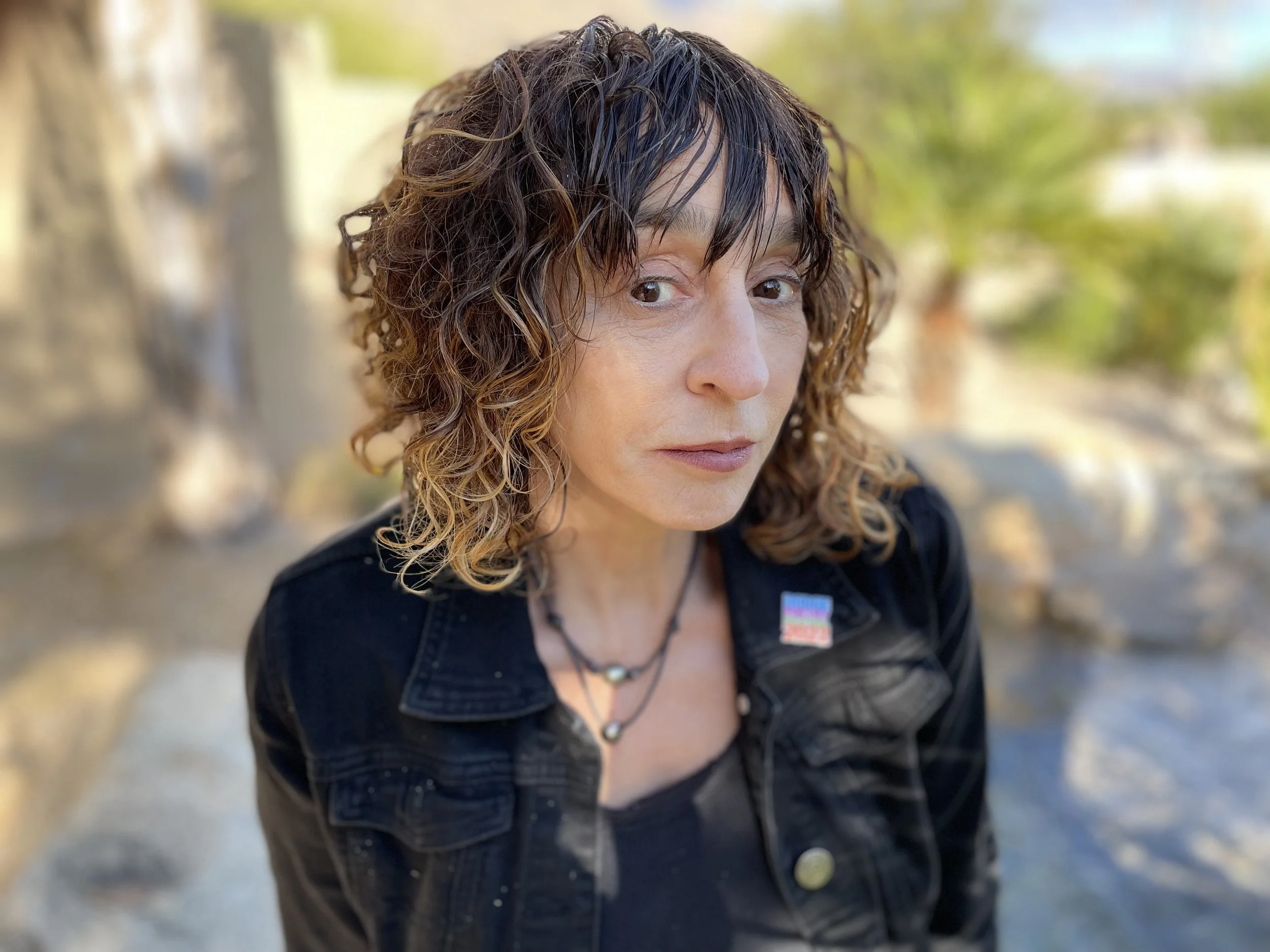
Kim Addonizio is the author of nine poetry collections, two novels, two story collections, and two books on writing poetry: The Poet’s Companion (with Dorianne Laux) and Ordinary Genius. Her poetry collection Tell Me was a finalist for the National Book Award. She also has two word/music CDS: Swearing, Smoking, Drinking, & Kissing (with Susan Browne) and My Black Angel, the companion to My Black Angel: Blues Poems and Portraits, a collaboration with woodcut artist Charles D. Jones. Her poetry has been translated into several languages including Spanish, Arabic, Italian, and Hungarian. Collections have been published in China, Spain, Mexico, Lebanon, and the UK. Addonizio’s awards include two fellowships from the NEA, a Guggenheim, two Pushcart Prizes, and other honors. Her latest collection is Exit Opera (W.W. Norton).
On November 12th, 2025, The Interlochen Review editors Ema Bekic, Romeo Caterino, and Quinn De Vecchi sat down to talk with Kim about cultivating creativity and community, the intersection between poetry and nonfiction, and her latest collection, Exit Opera.
Quinn De Vecchi: You're a very multi-talented and hybrid writer, but you're most well-known for your poetry. In your memoir, you use very specific imagery that is central in writing poetry, like physical sensations, for example. Could you talk about how your poetic background has influenced your nonfiction writing?
Kim Addonizio: Poetry taught me all the important things about writing. Most things that you do in poetry help you write better prose. Poetry is really good training for that. But there are things it doesn't teach you either. If you're writing fiction, it doesn't help you with figuring out character, plot development, and those kinds of things.
And with nonfiction, it's partly about finding the story in your own story. You're some version of yourself who’s talking about things that happened to you—so you're not making things up—but you still have to figure out how to shape them. [You have to figure out] how to create some kind of a whole that still has a theme or a meaning beyond just “this happened.” And that's really true about poetry too. Just [saying] “this happened”—[that’s] not really a poem.
Ema Bekic: In your collection Exit Opera, there’s a poem called “Existential Voyage,” in which the speaker addresses a disorientation in waiting. There’s a line that says, “to remember / that neither despair nor a dearth of taxis can last.” What led you to that particular image of the taxi and how do you think images of transit, waiting, and travel function throughout the collection as a whole?
KA: I haven't really thought about that at all. There are things that are revealed in your work that you don't even know you're doing. Somebody once asked me what my obsession was with fish because there were a lot of fish in my book, and I went, “Really?” I didn't even know that.
There is a lot about waiting. When I think about it, the first poem, “Exit Opera,” talks about [how] it's okay to wait. It's okay to abide and just see what comes next.
That line particularly, I don't know how it came to me. Sometimes, I feel like it is channeling. I've studied language a lot, and so when I sit down to write, there’s not a lot of times [that] I write garbage. But if I hit a certain level of language, it's like another part of my brain opens up, another room that I can't always gain access to, and when I do, I get into a flow state and things start happening. It's hard for me to actually know where particular things came from. Sometimes they just appear. There's some tapping into the universe.
Romeo Caterino: In Tell Me, there's a similar centering of specific images and details, starting as early as “The Numbers” with your images of sheep, rosary beads, falling bodies, and glass. In “Glass,” there’s a very atmospheric image in a bar. What is it about specific moments or images such as those that inspire you to put it into poetry? Is there any specific thing you're drawn to?
KA: Poetry operates through specifics. That's the details of life: the sensual details, the things we can see, smell, taste, touch, and hear. Those are the things that we all have in common as human beings—consciousnesses in a body that ages and dies. We're all in this mortal situation. The specifics are what make it [poetry] live. As granular as you can get with details, those are the things that help to give it a texture of lived life. As to how they arrive, it's a bit mysterious.
I used to feel like I had to take notes all the time; I'm not really a very observant person. My guy, Danny, he's much more [observant]. He'll go, “Did you see that woman doing blah, blah, blah?” and I'm like, “No.” I don't clock my surroundings as much as some people do, which is weird for a writer who's supposed to be observing everything. But then I find that things go in without my awareness. I'm just as surprised as anyone that somehow a part of me was recording anyway, even though I wasn't trying to. Anything that you experience or think about, whether it happens to you physically or not, it still goes into your brain, and when you're accessing that part of your brain that's really tuned into language, somehow those things come back.
QD: A lot of the real-life tales you include in Bukowski in a Sundress are extremely vivid and comedic, but at the same time, raw. How were you able to include such honest stories—like breakups, writer depression, or even a friend trying to commit suicide—and not feel like you were overburdening the reader?
KA: Well, the subtitle [of Bukowski in a Sundress] is Confessions from a Writing Life. And the confessional is a whole subject in “Whole Can of Worms,” too, that we could talk about. But early on, when I was a baby poet and just learning what poetry could be and not really knowing what it was, I heard Sharon Olds read, and I was blown away. I thought, “You can write about that in a poem?” I had no idea. I had the conventional idea of poetry: it's hearts and flowers, and you write it as a teenager when you have a crush on somebody. But the idea that poetry can encompass so much more, that it really is about all of the stuff of our lived lives, affected me greatly. I remember the night I heard her read in grad school. I went right home and stayed up all night writing a poem about boys and being a teenager at the pool, and the whole body image stuff. It freed me.
And ever since then, I've felt like I had permission. To me it's about honesty. I don't know why we would make art if it's going to be dishonest art. As vulnerable as I can be in my writing, I aim for that. I'm not aiming to keep people at arm's distance and say, “Hey, here I am up high dispensing some kind of wisdom or whatever.” I'm just trying to figure shit out in my life, and writing is my response to that. I think for many of us it is. You write through the questions that you have about your life, or you write through what your confusions are and what you're trying to figure out about being here. I mean “being here” in the largest sense, but also being here as girls/women.
That right away gives us a certain identity, and then beyond that, we have all these other identities. Whether we're parents or children, or whether we're gay, straight, bi, non-binary, or black or white. We have so many identities at the same time. But for me, the core identity is [that] I'm a human being on the planet. I'm just trying to write about what that feels like and what I think about that.
EB: There is a poem in Exit Opera called “Aria di Sorbetto,” and it ends with the line, “If you ask me / to love this world, yes, oh, yes, / I will.” How did you conceive of joy and love in the face of darkness and the many other themes of loss that the earlier poems explored?
KA: I've been trying to find more joy. I have a dark turn of mind. I realize that there are certain poems that I'm drawn to and certain poems of mine that people are drawn to that offer some solace. Empowerment, too, but solace and comfort in the face of [knowing] that somebody else went through this or somebody else found a way out of something.
That was part of the motivation. The “Aria di Sorbetto” is very interesting because operas before weren’t as fancy as they are now. Towards the end of the opera, they would always give an aria to a minor player, and that was their moment to have. That was called the “Aria di Sorbetto” because they would be going around with snacks, sorbet and things, and that was the last call for getting your snacks during the opera. I put it towards the end of my book because I wanted to bring the light up a little at the end. I wanted to find a joyful moment to include.
RC: Similarly, in Tell Me, you have the poem “Therapy,” and in that poem there's a really interesting line: “the whole sick drama of my childhood's on display like a document in a museum.” That's one of several poems in the collection that discuss your family, and there's almost this irony to it. Where did this irony come from and how did you continue to write about family despite the discomfort?
KA: That poem is a sonnet. It's a really early one too. It's also a poem about poetry.
When speaking to a therapist about your trauma, it’s ideal to not dwell in it, but to get to the other side of it. Talking about it and telling your story is one way to do that. Even though I don't think poetry is therapy, it has a really therapeutic aspect to it. It’s helpful to get your stuff out, even if you're just journaling.
That poem, in a way, was about getting through trauma because the end is, “Time’s up. You’re in the house. I'm through the door.” The speaker has just gotten it [trauma] outside of herself. It’s being able to take it out of the pain, look at it a little bit more objectively, and then begin. I always thought that trauma narratives are so interesting because I think many people are stuck in their trauma.
Talking about identities, that's one way [people are stuck]. Some people's identities are like, “see my pain.” I think that's a dangerous thing to lead with. But it's also a thing that can be affirming in a way, for women especially. I read this once, that women especially bond over sharing their pain. You meet somebody, you're starting to get close to them, and immediately you're telling each other your troubles and your dark stories. I don't think boys and men do that so often. It's this weird thing. But I'm always wary of getting stuck in that. The point is not to stay in it. The point is to transcend it in some way.
What doesn't kill you will make you strong once you get to the other side of it, so that it doesn't have that power over your life anymore, where you define yourself by your pain. With a lot of people that I've met, and a lot of my students who write, it's really great they're writing through these things, but I feel like they need to get past it. But you can't [force]. You can open the door, but you can't shove anybody through it.
QD: In Bukowski in a Sundress, specifically in “How to Succeed in Po Biz,” you talk a lot about failing as a writer, something that all writers experience. How have these failures influenced your writing?
KA: They [failures] do. Everything does. The beautiful thing about writing is [that] all your failures, even your failures in writing, you can write about them. You can turn them into something. Speaking of irony, that's a really funny, ironic piece [“How to Succeed in Po Biz”]. Humor is another way to bring some light to things. So when something's dark, if you can turn it a little bit and make it funny, it's a little easier to deal with.
I'm working on a new book called The Poetic Mind with a friend of mine. One of the chapters in there is about how each of us became a writer, and mine's called “Some Notes on Failure.” As we all do in life, we fail at things. We think we're going to do one thing, and that doesn't work out, and we do something else. It's a whole process. But really what I was trying to write about was how all of those “failures” led me to become the person and writer I am now. So, in that sense, I can't feel bad about them.
I have shattered dreams like anyone—I wanted to be a singer. That was my real goal in life. I found myself in college studying classical voice, and I had no idea what I was doing. I dropped out after two and a half years because I failed my junior recital. I wanted to be Joni Mitchell. I didn't know that I could take that training and do anything with it, and I really didn't want to be a classical singer, but that was what I thought I had to do, to go to music school.
It was a terrible experience for me, and I never sang again. But years later, [now], I sing a little bit at home, and I've become a singer in a different way. Even music, which I have “failed” at various times in my life, has come back into my life. You never know—all of the things that you end up learning through the things that you try and fail at, as a writer and as an artist, they serve you in a way. It's hard to see it when it's happening.
RC: In Tell Me, you frequently revisit similar themes in multiple poems. You revisit womanhood quite frequently, especially in the last quarter of poems, in poems such as “Getting Older,” “What Do Women Want,” “Good Girl,” and many more. Have you ever felt like you've exhausted a subject matter?
KA: I often feel like I don't have anything else to say, and that I'm written out after twelve books, then something always comes along. But I still go through these periods where, if I don't write for a while, I start to feel really bad about myself. I don't feel centered if I can't write. But then I'm writing in my journal, and somehow, mysteriously, things come back. The well starts to fill up, and I'm able to write again.
I think that the subject of being a woman in the world is something that is kind of inexhaustible, at least as long as we live in the world that we do, given how anti-woman this culture is, even though it’s better than a lot of cultures around the world. There's a lot to say as things keep happening. It's impossible for nothing to happen. Eventually, you feel you need to respond.
RC: Do you think it would be possible to exhaust a subject matter with poetry?
KA: I don't know. My subject matter is just life. Time and the fact of death is also getting to be more and more of a subject as I get older. That's why it's really important to find some humor, some light, and some solace. And, let's just say it's sobering.
EB: There's a poem “In Assisi,” and you say, “skinny wooden crucified Christs… I know my soul is small, it just wants a decent hotel room, / & the man who lies down to sleep so trustingly beside me / to open his eyes & love me.” That line creates this tension between the spiritual and the physical. How did you manage this pull between transcendence and the human experience in this poem, and elsewhere in Exit Opera?
KA: We're here in a physical body, and that is a big part of who we are, but we're also conscious of other things. It's that dual awareness that I feel, and that recognition is what comes out in the poems. There's some poetry that is very intellectualized, and then there's some poetry that's very emotional, and I think either end of the spectrum is not where we should be, because we are creatures of heart and creatures of intellect and spirit, as well. You can have all the passion in the world, but if you don't study language, you're not going to be a real artist. On the other hand, you may know a lot about all kinds of things, you may have all this subject matter at your fingertips, but if you don't have that driving thing inside, it's going to be pretty bloodless. It was Plath that said, “The blood jet is poetry. There's no stopping it.” I love that, but it's not just that. It needs the two sides of your brain. It needs the two parts of yourself, and not one without the other.
I've had a number of talented students in my classes over the years I've had all kinds of students in community colleges and in graduate programs. It's just so interesting to me that some people with talent don't have the discipline to do anything with it, to serve that talent, and so they don't become writers. You don't have to be a writer, but that's the thing. You have to have that drive from within and you need to have passion. All true artists have studied their art and studied other artists of the past and the present. There seems to be a tendency now to forget the artists of the past and just read contemporary work, and I think that really limits you in terms of what's possible. The more widely you read and discover all of the ways that people have made poems in the past and are making poems today, the more you have available to you to learn from.
Learning to write can be summed up in a nutshell as read, reverse engineer, and write. Figure out what somebody you love is doing and take it apart and then make your own version of it, and that, to me, is the simplest definition of learning to write, and basically how I learned to write.
RC: In Tell Me, there were themes of relationships, strangers, overwhelm, connectedness and how those define a life. But poetry is super subjective, so what theme or themes do you think unified Tell Me as a collection of poems?
KA: In terms of themes, I think you hit on them. It really is about questioning and confusion and trying to find one's way at a certain time of life. And I was asking all of these questions in my 30s, so I'm a late bloomer.
I didn't come to poetry until my late 20s, so when I started writing, I was about 28 years old. I think in a lot of ways, I was still trying to figure things out in that particular book. Reading C.K. Williams helped me a lot with writing the long lines. He's one of the people that I got really interested in for his syntax and his ability to follow a thought with a long line and qualify it like: “and she lived there, or maybe it was over there instead.” He had this way of qualifying his thinking in the line and I thought, “how does he do that?” So, I spent a lot of time reading him and figuring out the long line, which I'd never used before. Now, it's in my toolbox. It's one of the things I feel comfortable with. I often try different line links to figure out what the right one is.
EB: Throughout Exit Opera, there's this theatrical frame running through it. How did you think of this book structurally as a performance and how has that impacted how you ordered the poems or selected the language or form that you used?
KA: I'd written that poem “Exit Opera” first because I did a BBC radio show about the giant sequoias that were burning in California, and they wanted a poem for the radio show. So, I ended up writing that after a visit to the sequoias. We spent the night in a fire tower, which was very cool, and which you weren't supposed to do, but somehow my producer snuck us in. We were way up on this rock with nothing around us. The bathrooms were way down at the bottom of the stairs. Let's just say, it’s lucky there was a bucket. I wrote that poem about that trip. I liked the title I'd come up with, and I started thinking about that title as exits being endings, and then operas being singing.
One of the quotes in the book—that the book begins with—is Bertolt Brecht's “In the dark times, will there also be singing? Yes, there will also be singing about the dark times.” So, I thought that could work as the framework for a book.
I thought, “there's the exit, and the opera is just singing about it, so maybe I should write a couple more poems about opera.” That's what led to “My Opera” and “Aria di Sorbetto,” I wanted to make the book more cohesive. Operas are full of drama—great loves and murders and suicides—all those good things that happen in life, so I thought that was appropriate too.
I was conscious of that: writing some poems to the book itself and not just random poems, and thinking a lot about how to organize and put them together and move it into, by the end, something that rose up a little bit.
RC: What formal elements do you tend to be drawn to with your poems? Do you have a favorite, or do you tend to choose certain forms or elements to complement specific thematic material?
KA: I started out as a free verse poet, so I didn’t really learn about meter and rhyme until I took a class in grad school. That just opened me up when I discovered the sonnet. I spent a summer thinking in iambic pentameter and wrote a bunch of sonnets that summer, and I just fell in love with the form, and it's still a form I love. I still write a lot of 14-liners. I'm really into monorhyme sonnets right now. There are a couple in Exit Opera.
Some people find it to be like a straitjacket. But I always say that a serious poet has to learn those things; how would you understand the poetry in English—since Chaucer—if you didn't know what iambic pentameter was? That’s been the dominant form of English verse for hundreds of years now. Or how would you understand the brilliance of Shakespeare, who really was that good? Some of these dead white guys, maybe not, but Shakespeare really was that good. Edna St. Vincent Millay was pretty damn good, too. I'm just a big fan of the sonnet. That’s probably my favorite form, and I haven't investigated a lot of others.
But any formal element that you introduce into a poem is going to have generative results.Your imagination loves a puzzle and a problem, and it's immediately going to go to work thinking, how can I subvert this? Like, “They put a fence around me. Should I dig under it? Am I gonna climb over it? Am I gonna leap over it? Am I gonna look for a ladder?” Your imagination loves to solve these puzzles, and so that's the challenge and the fun—writing a sonnet and trying to make it sound natural.
QD: What inspired you to start writing nonfiction as opposed to just continuing to do poetry?
KA: [Before], I was writing short fiction. I published a couple of novels. I just got really disenchanted with fiction; I lost the urge to do it anymore. I can't remember exactly how I got started writing personal essays, but a book that influenced me a lot was Joanne Beard's The Boys of My Youth. I read that, and I thought, “Oh, that's how you write an essay.” Something about the way that she wrote suddenly spoke to me. I still don't understand much about structure, like structuring a short story, even though, somehow, I've written and published a couple of novels. I still don't understand how to write one, and it's way too much work. I never want to do it again.
God help me if I get an idea for a novel, I’d want to shoot myself first. Really, it's a nightmare. It's such a long slog, and you don't know where you're going or what you're doing. A poem, you can [know]. I really understand poetic structure. That's where my heart is, and that's where I live. But [Beard’s] book meant a lot to me, and she wrote those essays in a really interesting way. She's a wonderful writer. I read her, and that inspired me to write some more essays, and that was a large part of the genesis.
[Bukowski in a Sundress actually] came from a failed memoir. Which I cannibalized somewhat, but mostly I jettisoned. I tried to write a memoir that did not work out—it got rejected all over town. Then I went back one day, and I said, “You know, I like some of these. Maybe I can pull out some things and make them their own little individual pieces,” and so that was the real genesis of it.
QD: How have your experiences collaborating with other artists, specifically musicians, impacted how you write?
KA: Collaboration is a two-edged sword. I love collaborating, and I've done a few collaborations with musicians, and I did a chapbook with my friend Brittany Perham, with whom I'm writing a new book, The Poetic Mind. We collaborated on a chapbook together where she did drawings and we did our poems together, and now we're working on this book together. Danny and I, obviously, are collaborating with word and music.
Dorianne Laux and I wrote The Poet's Companion together. The upside is that you have a partner in crime and you have somebody else who's on the same project and you can commiserate. So it's really good for sharing the work and the support, but the other side of it is that you need to have the right collaborator or it can be counterproductive. You have to really find the right people and experiment and see what happens. The great thing is if it doesn't work out, then you know something about the kind of person you can't collaborate with. But it definitely creates a synergy where the sum of the parts is more than each person alone.
EB: Could you tell us a little more about The Poetic Mind and other projects that you've been working on more recently?
KA: The subtitle [for The Poetic Mind] is Create It, Craft It, Find Your Community, so it's another book similar to Poets Companion and Ordinary Genius, which are the other two books on writing that I've done. Ordinary Genius came out over ten years ago.
I've been teaching other classes and developing other ideas. And Brittany was a Stegner Fellow at Stanford, and she had a lot of stuff on creativity because she taught a class on it. So I thought this would be a cool project to put together.
It's got a bunch of writing exercises and prompts. The first section's all about creativity. Then we cover some of the usual stuff with craft that feels like everybody needs to acquaint or reacquaint themselves with. The third section is about how you find community. If you’re just writing your little solitary poems, or maybe you’re getting out of school, what's next? You have a community here [at Interlochen], you have a writing community, you have a creative community. What happens next, right? You need to find that [community] again or you need to find new people, as well as hold onto some of the old people.
Right now, I've got a handful of new poems, and I'm hoping to write more. I also have a new collection of essays that I'm calling Anywhere But Me. I'm not sure yet what's going to happen with that. It's mostly done. Then Danny and I are making an album. I don’t know what will happen after that,but I trust that something new will come along.